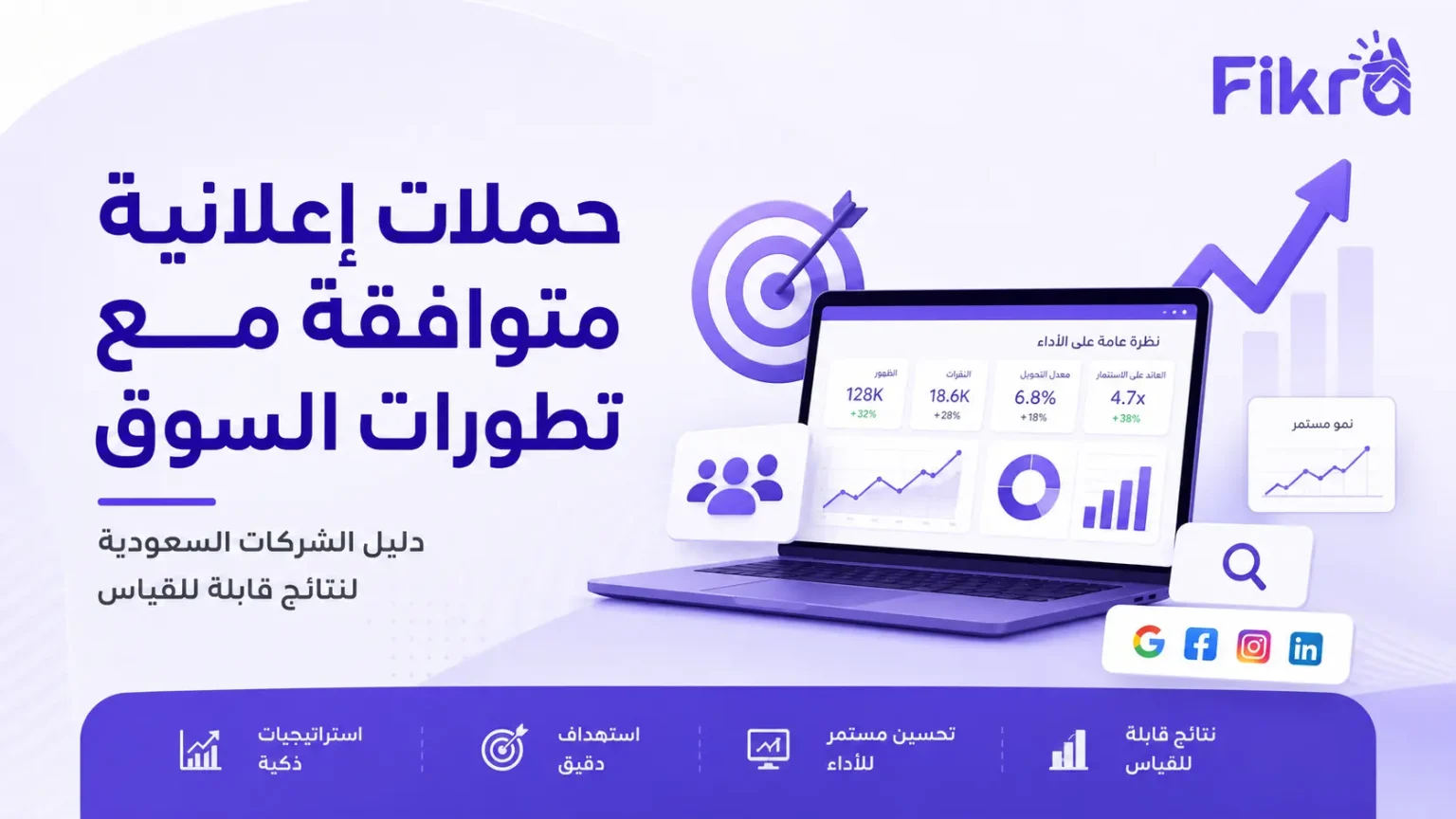
What are market-aligned ad campaigns?
A campaign that continuously evolves with performance data, behavior, and platform — not a static ad repeated for months.
With 34.4M internet users and 38.6M social identities in Saudi Arabia in 2026, the challenge isn't finding customers — it's reaching them amid heavier competition and higher ad costs.
Market-aligned campaigns evolve based on data, customer behavior, platform performance, and competitive trends — not by repeating the same ad for months.
This approach treats advertising as a full marketing system that starts with understanding the customer and ends with measuring the outcome.
Saudi buyers compare multiple options before contacting or buying. Winning campaigns reach the right person, with the right message, at the right time, and lead to a measurable next step.
Why Saudi companies need modern campaigns
Shifting behavior, rising costs, and audience fatigue force Saudi companies to modernize how they run ads.
Customers no longer decide based on a single ad. Their journey spans social, Google search, your landing page, response speed, and brand trust.
Behavior shifts, competition density, platform fragmentation, rising acquisition costs, and message fatigue all push companies toward modern campaigns.
Brands that adapt control budgets better; brands that repeat the same messages keep paying more for less.
How modern marketing trends affect campaigns
Data, message personalization, and conversion measurement now matter more than budget size.
DataReportal puts Saudi internet users at 34.4M (99% penetration) with 48.7M mobile connections — a digital-first, mobile-first market with sharper competition for attention.
Modern campaigns rely on data over guesswork, audience-specific messaging, paid+SEO integration, smart retargeting, landing page UX, and conversion-focused measurement.
The Saudi customer journey: why one platform isn't enough
Saudi buyers hop across social, search, your site and WhatsApp — one platform is never enough.
Relying on a single platform is a common, expensive mistake. The customer often starts on social, searches your brand on Google, visits your site, reads reviews, then messages on WhatsApp.
Any weak step — slow landing page, late reply — loses the lead even with a great ad.
Modern campaigns design the whole journey, not isolated ads.
Signs your campaign is no longer market-fit
Rising CPL, clicks without sales, and stale creatives are signs your campaign is out of sync with the market.
Campaigns decline gradually: rising CPL, fewer sales per click, weaker lead quality, less engagement on stale creative.
Key red flags: single-platform dependency, no conversion tracking, no creative testing, low landing-page conversion, unclear ROI per channel, sales team complaining about lead quality.
One signal alone isn't failure — it's a prompt to analyze, not to raise the budget.
Traditional campaigns vs market-aligned campaigns
Traditional: a fixed ad with equal budget split. Modern: continuous testing, conversion tracking, and performance-based shifts.
Traditional: launch & wait, pick platforms by familiarity, measure clicks, static creative, fixed budget split, landing page = a link, limited tracking.
Market-aligned: continuous test/measure/improve, platform chosen by behavior, conversions over clicks, flexible messaging, performance-based budget reallocation, landing page as a conversion engine, tracking set up before launch.
Many brands lose to ad management — not to product quality.
Strategies to build a market-aligned campaign
Set the goal, study the audience, pick the platform, prep message+landing, enable tracking, then test and optimize.
1) Define the business goal precisely.
2) Understand the audience deeply: blockers, objections, journey stage.
3) Choose the right channel: Google for high intent, social for awareness and retargeting.
4) Write messages that solve a real problem, not generic claims.
5) Set up tracking before launch — Google emphasizes conversion tracking as the basis of optimization.
Social media ads vs Google Ads
Google for active intent, social for awareness and retargeting — the best mix follows the customer journey.
Use Google when intent is explicit and purchase is imminent. Use social for awareness, visual products, and decisions that need repetition.
Clinics: Google+Meta. Restaurants: Snapchat/Instagram/TikTok. E-commerce: Meta/TikTok/Google. B2B: LinkedIn/Google. Home services: Google Search+WhatsApp. Education: Meta/TikTok/Google.
The best mix supports the entire journey, not a single channel.
Paid ads & retargeting
Paid ads open the door; retargeting closes the sale with stage-specific messages.
Paid ads buy reach; retargeting makes that reach efficient by re-engaging warm visitors with stage-appropriate messages.
Use it for cart abandoners, service viewers, page-specific upsells, win-back, and CRO on past traffic.
Don't repeat the same ad — vary by stage to reduce waste and lift conversions.
How to distribute budget across platforms
Allocate by performance, not equally: start with a test budget, then scale winners and pause losers gradually.
Splitting budget equally is the most common mistake — let performance, intent, and goal drive allocation.
Start with a test split, then scale winners and pause losers gradually.
Compare CPL to your margin — not to clicks. Don't scale before you understand quality.
Choosing the right KPIs
Focus on CPL, CPA, ROAS and lead quality — clicks alone can mislead you.
Wrong KPIs make losing campaigns look successful.
Track CPL, CPA, conversion rate, ROAS, lead quality, close rate, and LTV.
Clicks alone don't prove success — the truth is in qualified leads, bookings, and sales. Google highlights conversion tracking as the foundation for ad optimization.
The ad message and landing page
Sharp message + fast clear landing page + visible WhatsApp button = higher conversion without raising spend.
Strong messages aren't long — they're specific to the customer's problem. Replace generic claims with concrete benefits.
Landing pages decide conversion: clear headline, short value pitch, CTA, visible contact, WhatsApp button, trust signals, mobile speed, simple design.
Page improvements often beat new ads. Sometimes you need a clearer page, not more spend.
How response speed affects results
Slow replies burn budget. Prep your response team and templates before launch.
Great targeting fails if responses are slow. In Saudi Arabia, WhatsApp and direct calls drive decisions.
Slow replies hurt conversion rate, raise CPL, waste hot leads, and burn budget.
Prepare your response team before launch, with templates, follow-up SOPs, and easy contact channels.
When you need professional campaign management
When ads drive growth across multiple platforms, pro management prevents waste and multiplies returns.
You need pro management once ads become a primary growth channel and the cost of mistakes scales.
Watch for: spending without ROI clarity, multi-platform without strategy, clicks without sales, rising CPL, no tracking, no monthly reports, sales-team friction, no creative testing.
A good agency starts with your business model, margins, sales cycle, and past channels — not with budget alone.
How Fikra helps you build market-aligned campaigns
We start with a free diagnostic, build a plan around your business, set up tracking, and deliver clear monthly reports.
We start by auditing channels, spend, lead quality, waste sources, landing page performance, response speed, and tracking accuracy.
Then we refine channel mix, messaging, targeting, landing pages, conversion tracking, reporting cadence, and lead quality.
The goal is a transparent ad system: know what's spent, what's earned, and what to improve next. Book a free diagnostic to see where your campaigns stand today.
Combining SEO with paid ads
Ads bring quick results, SEO builds compounding growth — combining them lowers long-term CPL.
Ads bring speed; SEO builds long-term presence. Combined, they form a stronger growth system.
Ads reveal high-converting keywords; SEO converts them into evergreen content; optimized pages lift conversions; organic visibility reduces ad dependency.
Brands that combine both build more stable digital presence — a core trend in modern marketing.
Common mistakes that fail great-looking ads
No tracking, weak landing pages, broad targeting, and stage-mismatched messages — the deadliest mistakes.
No tracking, weak landing pages, overly broad targeting, message-stage mismatch, slow replies, no A/B testing, and judging campaigns too early — all sink otherwise great ads.
Fixing these often improves results without raising spend.
How to build a periodic review system
Weekly performance, monthly messages and platforms, quarterly strategy — a rhythm that prevents losses from piling up.
Weekly: spend, CPL, lead quality, ad performance. Monthly: messages, audiences, platforms, landing pages. Quarterly: strategy, market shifts, competition, behavior.
This rhythm catches problems early instead of months later.
Saudi markets move fast — adaptive campaigns win on targeting accuracy, message clarity, landing page quality, response speed, and tracking strength, not just budget size.
Looking for ad campaigns that match the Saudi market?
Book a free diagnostic with Fikra to see where your campaigns stand and what to improve before spending more.
Book Free DiagnosticFrequently Asked Questions
What are market-aligned ad campaigns?+
Campaigns continuously updated based on customer behavior, platform performance, competition, and measured results — not a static ad running for months.
How are modern campaigns different from traditional ones?+
Modern campaigns rely on data, testing, tracking, and budget reallocation; traditional ones rely on a fixed ad and limited measurement.
How do strategies reduce ad waste?+
By choosing the right audience and platform, refining the message, and measuring precisely instead of guessing.
Social ads or Google Ads — which is better?+
It depends on intent: Google for active searches, social for awareness, retargeting, and demand creation.
When do I need professional campaign management?+
When you spend without knowing ROI, run multiple platforms, or face rising CPL and weak lead quality.
How do I know my campaign is wasting budget?+
Lots of clicks but no sales, rising CPL, unclear lead sources, or missing conversion data.
Is retargeting necessary for every business?+
Important for most businesses — especially when buyers compare options. Vary the message by customer stage.
What's the most important factor in campaign performance?+
There's no single factor — performance depends on the integration of targeting, message, platform, landing page, response speed, and tracking.
Read also & relevant services
Sources & References
Fikra Team
Paid Media & Performance Experts
Fikra's team specializes in Google, Meta, TikTok and Snapchat campaigns for the Saudi & Gulf markets, with 8+ years optimizing CPL and ROAS across clinics, e-commerce, services and B2B.
